
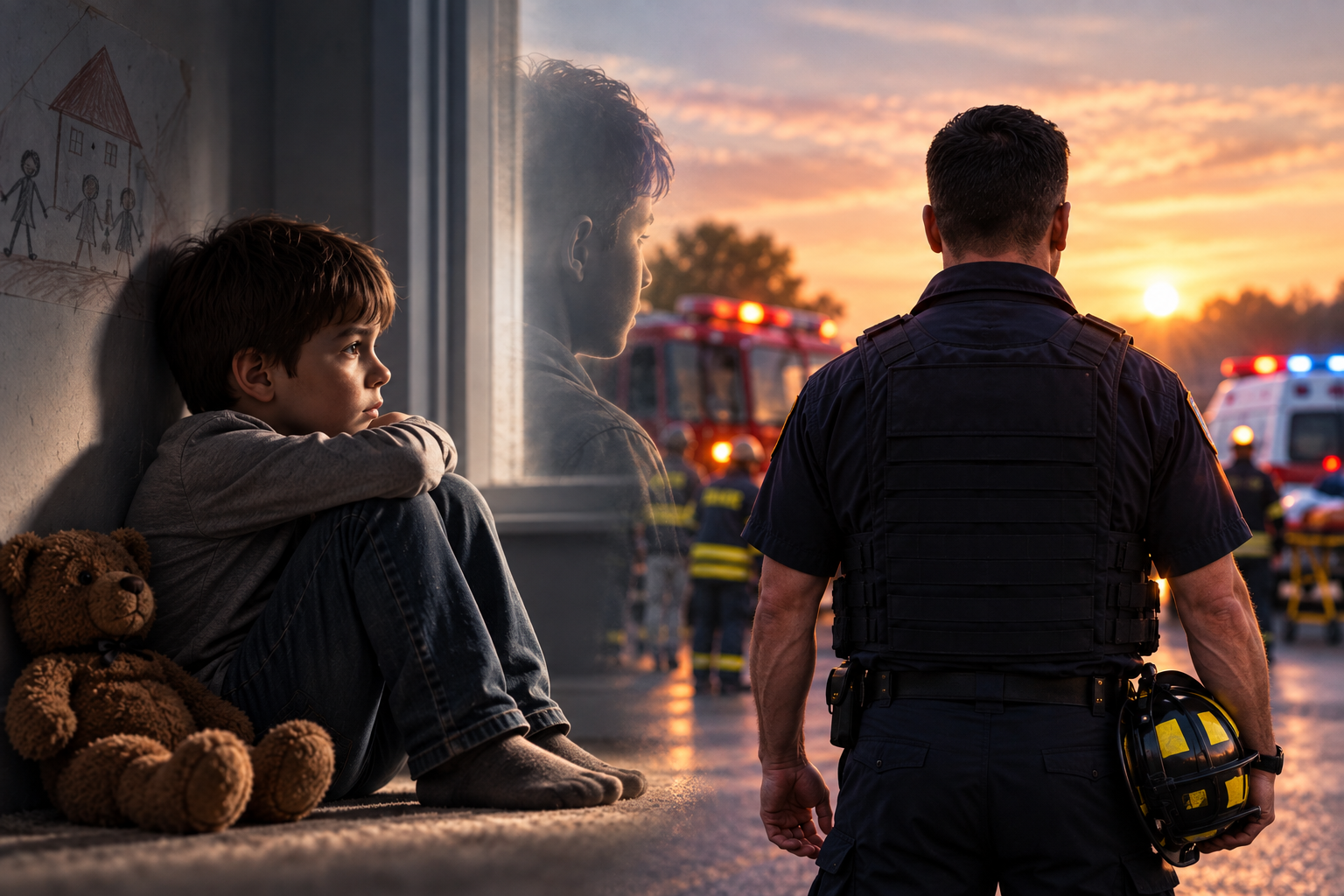
There is something we do not talk about enough when we discuss first responder PTSD, first responder mental health, and the mental health of military personnel:
Sometimes the trauma did not start with the job.
Before the badge, before the firehouse, before the ambulance, and before the uniform, there was a person with a history.
For some, that history included stability, safety, and strong relationships. For others, it may have included childhood abuse, neglect, addiction in the home, domestic violence, instability, loss, or other traumatic experiences that required them to grow up much faster than they should have.
These experiences are often referred to as Adverse Childhood Experiences, or ACEs.
And they matter.
Research involving police officers has found significant associations between ACE exposure and symptoms of PTSD and depression later in life (Hartley et al., 2022).
This gives us another way of looking at first responder mental health.
The question may not only be:
“What happened to you on the job?”
Sometimes we also need to ask:
“What happened before you ever put on the uniform?”
What Are ACEs?
Adverse Childhood Experiences, commonly called ACEs, are potentially traumatic or highly stressful experiences that occur during childhood.
They can include:
- Physical, emotional, or sexual abuse
- Physical or emotional neglect
- Domestic violence in the home
- Growing up around substance use
- A parent or caregiver with serious mental health problems
- Parental separation or divorce
- Having an incarcerated household member
- Chronic instability or dysfunction within the home
The connection between ACEs and first responders is important because early adversity can influence how a person learns to respond to stress, danger, relationships, and emotions.
Not everyone who experiences childhood adversity will develop PTSD, addiction, depression, or relationship difficulties.
An ACE score is not someone’s destiny.
However, childhood is a time when we begin learning what safety feels like, whether other people can be trusted, how emotions are handled, and what we need to do when something feels threatening.
Those lessons can follow us into adulthood.
Childhood Trauma and First Responders: When Survival Skills Become Strengths
This is where the conversation gets interesting.
Some characteristics that develop in response to difficult childhood environments may look very different in adulthood.
A child who constantly watched the room may become an adult who is extraordinarily aware of their surroundings.
A child who learned to stay calm during chaos may become someone who performs exceptionally well during emergencies.
A child who learned to take care of everyone else may grow into an adult who feels most valuable when protecting or helping other people.
A child who learned not to show fear may become an adult others describe as incredibly strong.
These qualities can be tremendous strengths.
They may also come at a cost.
Hypervigilance can look like preparedness.
Emotional suppression can look like composure.
Taking responsibility for everyone can look like leadership.
Never needing anyone can look like independence.
This does not mean that childhood adversity causes someone to choose law enforcement, firefighting, emergency medicine, or military service. Research does not establish that simple cause-and-effect relationship.
Instead, understanding childhood trauma and first responders means recognizing that early experiences may interact with the demands and stressors of the profession someone later chooses.
When First Responder Trauma Meets Earlier Trauma
First responders do not experience stress just once.
They experience it repeatedly.
The fatal accident.
The child who could not be saved.
The domestic violence call.
The suicide.
The shooting.
The fire.
The overdose.
The notification to a family.
Then they go home, sleep if they can, and return for another shift.
For someone with significant childhood adversity, these experiences may be landing on a nervous system that has already spent years learning how to survive threat.
This is one reason understanding first responder trauma requires looking beyond a single traumatic event.
Research in military populations helps us understand this relationship.
A meta-analysis involving more than 50,000 military personnel found an association between ACEs and PTSD symptom severity even after researchers accounted for combat exposure (Blais et al., 2023).
Research involving more than 8,000 Marines also found that experiencing multiple categories of childhood adversity was associated with an increased likelihood of post-deployment PTSD (LeardMann et al., 2010).
These findings are also relevant to conversations about military PTSD and veteran mental health.
The important point is not that someone was “damaged” before entering the profession.
It is that trauma can be cumulative.
The call that finally overwhelms someone may not be the whole story.
It may simply be the point where a lifetime of carrying too much becomes impossible to keep carrying in the same way.
Why Some First Responders Don't Know They're Struggling
First responders are exceptionally good at functioning.
That is part of the problem.
You can be highly competent and still be struggling.
You can respond to emergencies, supervise other people, raise children, earn promotions, work overtime, and appear completely put together while internally experiencing anxiety, depression, intrusive memories, anger, emotional numbing, or exhaustion.
For years, your coping mechanisms may work.
Until they don’t.
That can be confusing for the person experiencing a mental health issue.
They may think:
“Why is this happening now?”
Sometimes the better question is:
“How long have I actually been carrying this?”
First Responder Addiction: When Substances Become a Way to Turn Everything Off
For someone whose nervous system rarely shuts down, alcohol or other substances can provide temporary relief.
For a few hours, the mind gets quieter.
Sleep may come easier.
The memories may feel farther away.
The body finally relaxes.
That does not mean every first responder who drinks has an addiction. But it does mean we should understand the function of the behavior.
What is the alcohol doing for them?
What is the substance helping them avoid, numb, quiet, or tolerate?
This is an important part of understanding first responder addiction.
When childhood adversity, occupational trauma, PTSD, and substance use begin overlapping, treatment may need to address more than the substance itself.
A nationally representative study of 4,069 U.S. veterans found relationships between particular ACEs and current alcohol and drug use disorders. Researchers emphasized the importance of addressing unresolved childhood trauma as part of substance-use treatment for veterans (Moore et al., 2024).
At Guiding With Care, we believe recovery needs to look beyond the behavior and ask what the behavior has been trying to accomplish.
The Trauma Can Follow You Home
A first responder may be incredibly effective during a crisis and still struggle when they walk through their own front door.
At work, hypervigilance may keep you alive.
At home, it can make it difficult to relax.
At work, emotional compartmentalization may allow you to complete the call.
At home, your partner may experience it as emotional distance.
At work, taking control may be necessary.
At home, that same response can create conflict.
The survival skills that help someone function professionally do not always translate easily into intimate relationships.
This is why first responder mental health cannot only be about reducing PTSD symptoms.
We also need to talk about marriages, parenting, intimacy, trust, anger, identity, addiction, isolation, and the ability to feel safe when there is no emergency.
A family member may notice changes before the first responder recognizes them in themselves.
That is why family involvement can be an important part of meaningful mental health care.
The Hardest Skill May Be Letting Someone Help You
There is an irony in first responder culture.
We train people to recognize when someone else needs help.
Then we create cultures where admitting that you need help can feel like weakness.
For someone who grew up learning that depending on other people was unsafe, asking for help can be even harder.
They may have spent their entire life surviving by thinking:
“I’ve got it.”
“I’ll handle it.”
“Don’t worry about me.”
That strategy may have helped them survive childhood.
It may have helped them succeed professionally.
Eventually, however, it can become incredibly lonely.
This is where peer support for first responders can make a meaningful difference. Connecting with people who understand the culture, demands, losses, and pressures of service can make reaching out feel less threatening.
You do not always have to explain everything to someone who has already learned to understand the language of the job.
Treatment Has to Look at the Whole Person
We cannot treat a first responder as a collection of symptoms.
We need to understand the person underneath the uniform.
That means looking at:
- Childhood experiences and ACEs
- Occupational trauma
- PTSD and cumulative stress
- Moral injury
- Substance use
- Depression and anxiety
- Relationships and family
- Identity
- Career and retirement transitions
- Legal and employment conc
Research & References
Hartley, T. A., et al. Adverse Childhood Experiences and Police Mental Health. Read the study.
LeardMann, C. A., et al. Do Adverse Childhood Experiences Increase the Risk of Postdeployment Posttraumatic Stress Disorder in U.S. Marines? Read the study.
Clarifying the Association Between Adverse Childhood Experiences and Postdeployment PTSD Symptom Severity: A Meta-Analysis and Large-Sample Investigation. Read the study.
Moore, A. S., et al. Sex, Adverse Childhood Experiences, and Substance Use Disorders in U.S. Military Veterans. Read the study.
About the Author
Written by Kimberly Lou, Ph.D., LAADC, Addiction Specialist.
Reviewed by Joshua Martin, M.A., CAADC, Veteran and Addiction Specialist.