
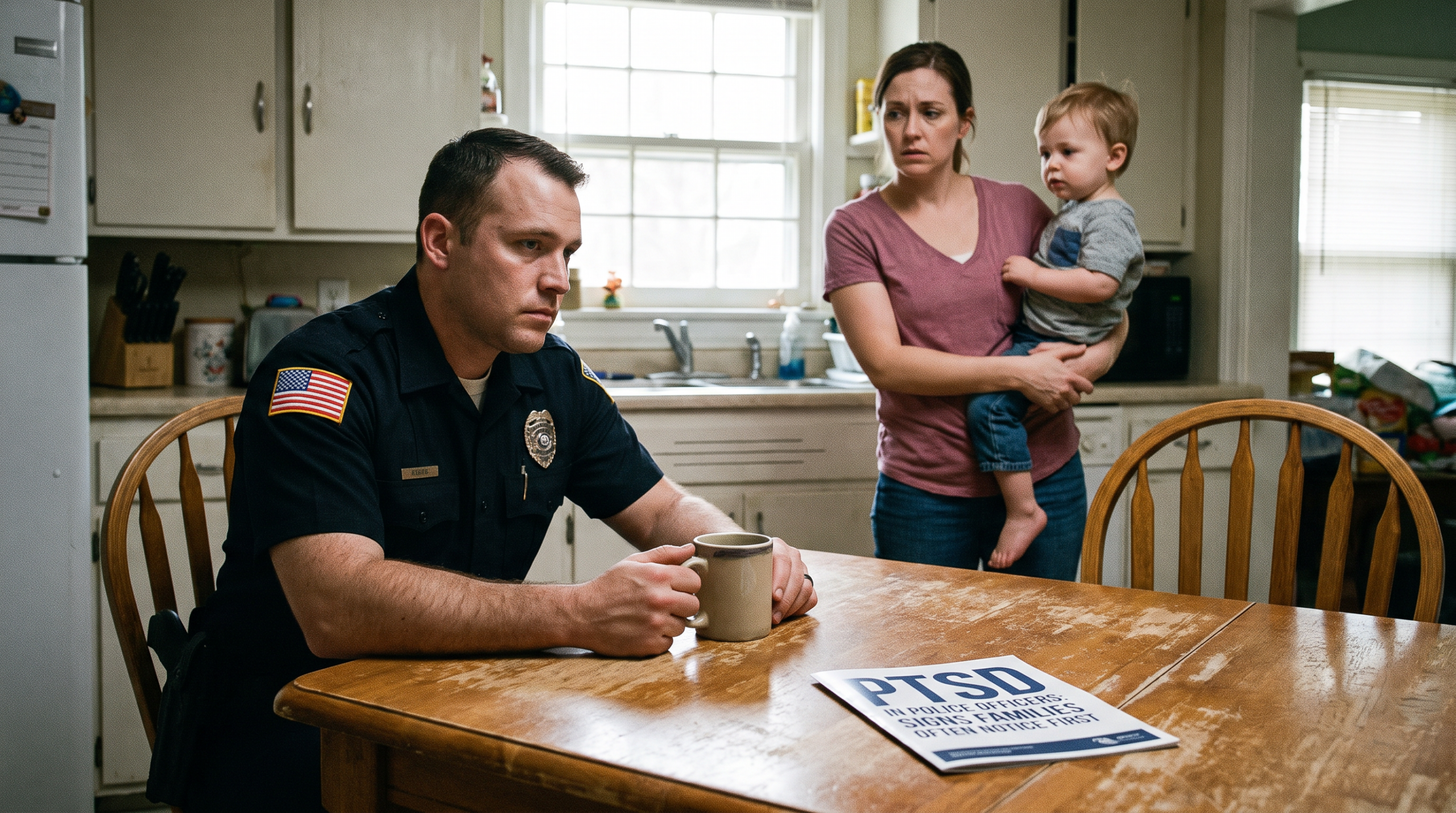
Sometimes, the person experiencing PTSD is not the first person to notice that something has changed.
A spouse may notice shorter conversations. A partner may feel like they are walking on eggshells. Children may wonder why a parent who once laughed easily now seems distant, tense, or distracted.
The family may not know what is happening at first. They may simply think:
“Something is different.”
For police officers and other first responders, repeated exposure to danger, violence, death, and suffering can affect life long after a shift ends. Post traumatic stress disorder (PTSD) does not always look like a dramatic breakdown. Sometimes, it looks like a person slowly becoming harder to reach.
Learning the signs of PTSD can help family members recognize when someone may need support.
PTSD Does Not Always Look the Way People Expect

Many people think PTSD only means flashbacks or nightmares. These can be symptoms, but there is much more to PTSD.
A police officer may experience:
- Unwanted memories
- Avoidance
- Sleep problems
- Irritability
- Anxiety
- Hypervigilance
- Emotional withdrawal
- Difficulty concentrating
- Emotional numbness
A traumatic event can trigger PTSD, but repeated exposure to stressful situations can also affect a first responder over time.
Research has found meaningful levels of PTSD symptoms among police officers following work-related critical incidents. Rates vary between studies, but the findings show why first responders wellness and mental health support are important.
The first step is knowing what to look for.
“They Are Not the Same Person Anymore”
One of the first signs may simply be a change in behavior.
A police officer may become more serious, distant, frustrated, or withdrawn. They may stop joining family activities or lose interest in things they once enjoyed.
The change may happen slowly.
A spouse may think:
“I know this person. This is not how they used to be.”
That feeling matters.
It does not automatically mean PTSD. Stress, exhaustion, mental health conditions, physical health problems, and other mental health issues can cause similar changes.
Still, a major or lasting change is worth discussing with mental health professionals.
Irritability and an Increased Stress Response
Irritability can be one of the first things a family notices.
A small problem may lead to a strong reaction. A simple question may feel like criticism. Noise from children may suddenly become overwhelming.
A police officer’s body may also stay in a strong stress response after the danger has passed.
During an emergency, the body releases hormones that help a person react quickly. This response can increase heart rate, breathing, alertness, and blood pressure.
This is part of the body’s natural survival system.
For some first responders, however, their body may have difficulty returning to a calm state after repeated stressful experiences.
What Is an Adrenaline Dump?
Symptoms of High Adrenaline After a Critical Incident
You may have heard first responders discuss an adrenaline dump.
So, what is an adrenaline dump?
A sudden release of adrenaline and other stress hormones that can happen when the body senses danger or extreme stress.
During an adrenaline dump, a person may experience:
- Rapid heart rate
- Increased blood pressure
- Shaking
- Sweating
- Fast breathing
- Muscle tension
- Extreme alertness
- A strong urge to act
These are some common adrenaline dump symptoms.
After the event, the person may feel exhausted, shaky, emotionally drained, or unable to relax.
Repeated adrenaline dumps may be difficult for people who regularly experience dangerous or high-pressure situations.
First responders may experience symptoms of high adrenaline during or after a stressful call.
They may feel restless, alert, tense, or unable to sit still. They may also have trouble sleeping or feel easily startled by a loud noise.
The body’s adrenal glands play an important role in the release of stress hormones such as adrenaline.
This response is helpful when immediate action is needed. But after repeated exposure to traumatic situations, learning healthy coping mechanisms and ways to calm the body can become important.
Simple strategies such as slowing your breathing, taking a deep breath, and creating a safe environment may help the body begin to settle.
These techniques are not a replacement for professional treatment, but they can be useful tools.
Sleep Problems May Be an Early Sign
Trauma can affect sleep in many ways.
A police officer may have trouble falling asleep, wake frequently, experience nightmares, or feel tired throughout the day.
Some officers may find it difficult to relax because staying alert has become part of their normal routine.
A family may notice the effects before understanding the cause.
Poor sleep can lead to exhaustion, difficulty concentrating, irritability, and changes in mood.
They May Avoid Places and Activities
Someone who once enjoyed restaurants, vacations, family gatherings, or social events may begin avoiding them.
They might simply say:
“I don’t feel like going.”
Avoidance can be a way of managing distress. Certain places, sounds, people, or situations may remind someone of a traumatic event.
The family may see this as rejection.
The officer may see it as a way to feel safe.
Understanding the difference can help families respond with concern rather than judgment.
Emotional Numbing Can Create Distance
Not everyone with PTSD appears anxious.
Some people become emotionally disconnected.
They may stop reacting to things that once mattered. They may seem distant or detached. They may say they are fine because they do not know how to explain what is happening inside.
For a spouse or other family members, this can be painful.
Emotional numbing can affect communication, intimacy, parenting, and relationships.
Alcohol Can Become a Coping Mechanism
Some first responders use alcohol or other substances to manage stress, sleep problems, emotional pain, or unwanted memories.
This does not mean every officer who drinks has a substance use disorder.
But the pattern matters.
If alcohol becomes a regular way to shut down after a difficult shift, it may be worth asking:
“What is the alcohol helping this person avoid or quiet?”
Understanding the reason behind the behavior can help guide treatment.
For some people, first responders rehab or trauma-focused recovery services may be appropriate. The right approach depends on the person’s needs.
Silence Does Not Always Mean Everything Is Fine
Some officers stop discussing work because they want to protect their families.
They may think:
“I don’t want to bring this home.”
But trauma does not always stay at work.
It can come home through silence, anger, nightmares, exhaustion, emotional distance, and avoidance.
Work-related traumatic stress can also affect relationships and family functioning.
That is why support should include both first responders and their loved ones.
How to Help a Police Officer With PTSD
If you are wondering how to help a police officer who may be struggling, start with concern instead of blame.
Instead of:
“You need to get help.”
Try:
“I’ve noticed that you haven’t seemed like yourself lately, and I’m worried about you.”
Be specific. Discuss changes in sleep, drinking, anger, withdrawal, or family involvement.
Do not pressure the person to share traumatic experiences before they are ready.
At the same time, do not ignore serious or unsafe behavior.
If you are asking, “How do I get help?”, reaching out to a qualified professional is a good place to start.
Sometimes the hardest step is simply to ask for help.
Responders First: Finding the Right Support
Recovery does not look the same for everyone.
Some people may benefit from therapy. Others may need addiction treatment, family support, peer support, or a combination of services.
A first responders wellness center can provide resources designed around the unique challenges of emergency professionals.
Finding a provider that understands first responder culture can also make it easier to talk openly about trauma, stress, and recovery.
The goal is not to erase the person’s strength.
to help them use that strength in a healthier way.
First Responder Mental Health and Recovery
At Guiding With Care, we believe first responders deserve compassionate, individualized support.
Our approach looks beyond one symptom or one diagnosis. Trauma, substance use, relationships, stress, emotional regulation, and earlier life experiences can all be part of the story.
If you are a police officer struggling with PTSD, or one of your family members is concerned about you, you do not have to figure it out alone.
Responders first. Your well-being matters.
Whether you are looking for first responders rehab, mental health care, or other recovery resources, taking the first step can make a difference.
How to help yourself? Ask for help.
Call Guiding With Care: (949) 397 7902
Find the balance in living… because you deserve to thrive.
A Final Thought for Families
You may be the person who notices first.
You are not responsible for fixing everything.
You simply noticed that someone you love may be hurting.
Sometimes, that is where change begins.
You can ask for help while you are still standing.
About the Author
Written by Kimberly Lou, Ph.D., LAADC, Addiction Specialist.
Reviewed by Joshua Martin, M.A., CAADC, Veteran and Addiction Specialist.